When America Kept Running Out of Money
Before the Federal Reserve, the United States had thousands of different banknotes, contagious bank runs — and an Ohio posse that once jumped over a bank counter and seized the money.
Based on the Federal Reserve Bank of Cleveland Fed Talk, “The Crises That Led to the Fed's Creation: Monetary Policy in American History,” presented July 16, 2026, by economist emeritus Owen F. Humpage. By Lindsay Hiebert.
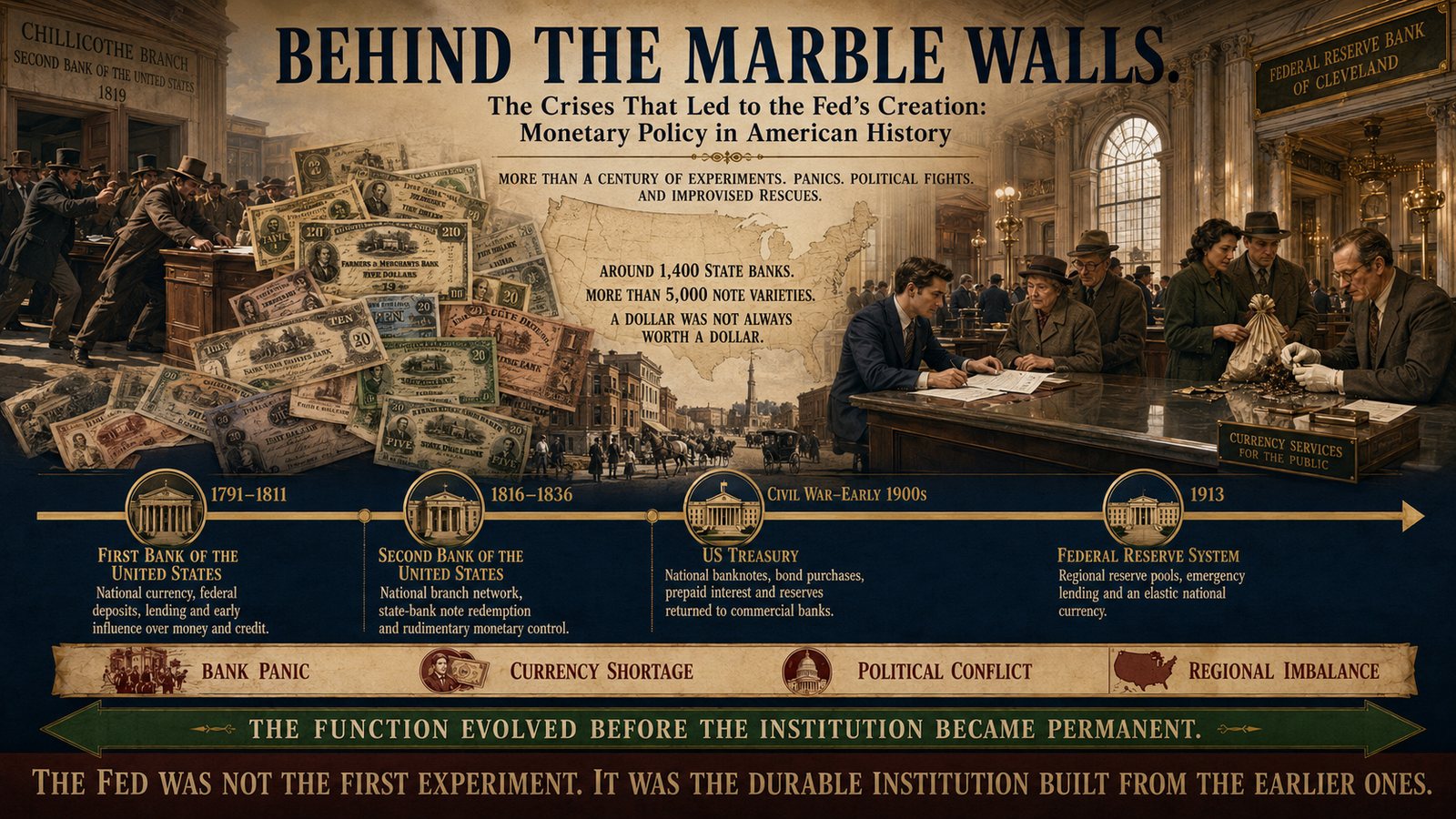
In 1819, the State of Ohio decided to collect a tax from a branch of the Second Bank of the United States in Chillicothe. The federally chartered bank refused to pay.
Ohio's state auditor responded by assembling a group of men and sending them into the bank to take the money. According to the story related by Cleveland Fed economist emeritus Owen F. Humpage, the instructions even permitted the men to “hop over the counter.”
They did. The men entered the Chillicothe branch, went behind the counter, and seized approximately $120,000.
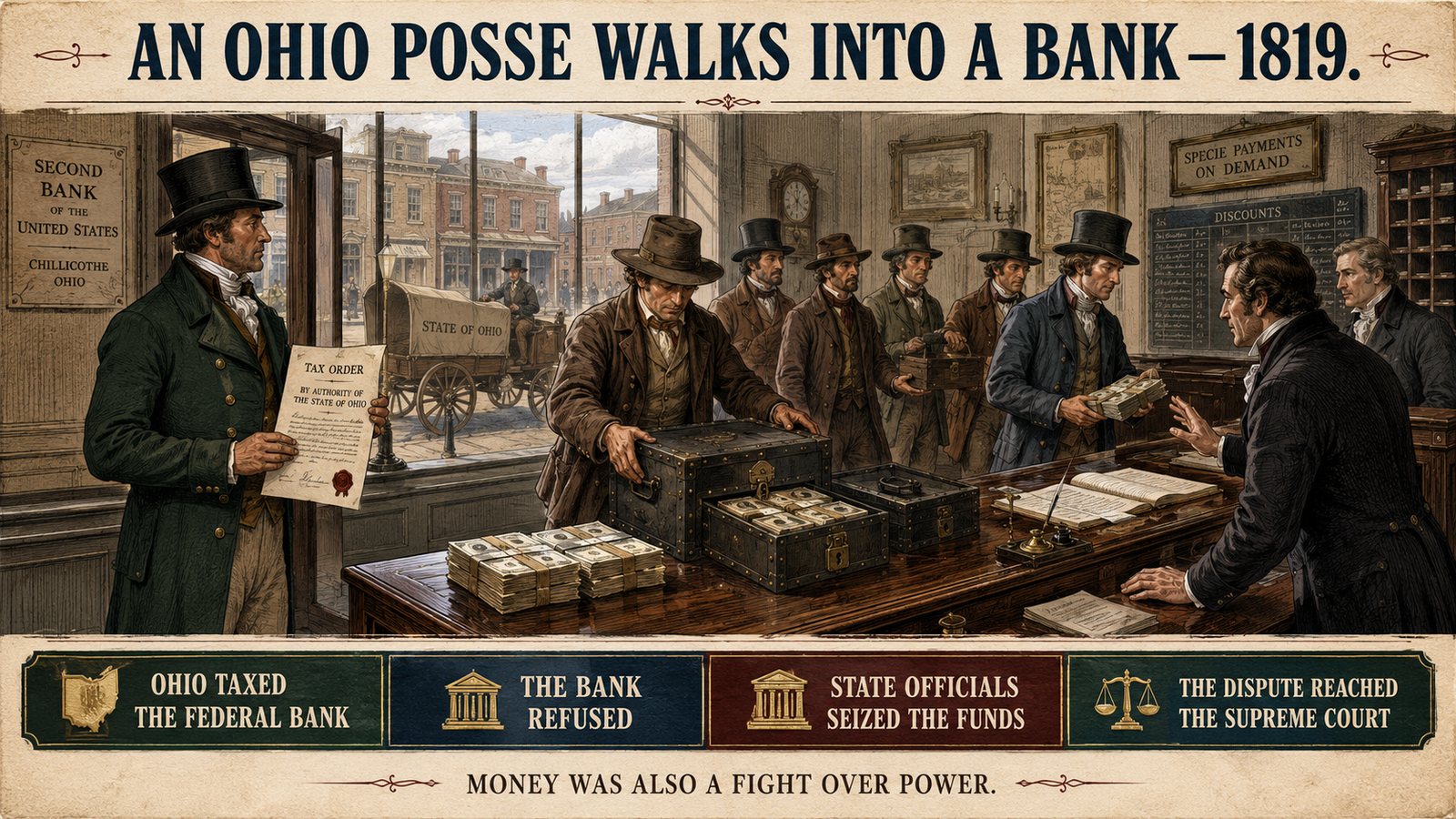
The courts ordered much of the money returned. The state auditor reportedly spent a short period in jail, and the dispute eventually reached the Supreme Court in Osborn v. Bank of the United States. The Court held that the Ohio law was unconstitutional and that the officials were responsible for returning the money.
It sounds less like monetary policy than the opening scene of a frontier crime story. Yet the episode reveals something fundamental about the early history of American money: banking was never only about interest rates, coins, or accounting. It was also a battle over political power, states’ rights, federal authority, public trust, and who would control the nation’s financial machinery.
That was one of the memorable stories Humpage told during the Federal Reserve Bank of Cleveland’s July 16, 2026, Fed Talk, The Crises That Led to the Fed’s Creation: Monetary Policy in American History. He presented the Federal Reserve not as an institution invented in a single moment, but as the eventual product of more than a century of failed experiments, political fights, financial panics, and improvised rescues. The Fed did not suddenly appear in 1913 because someone discovered the perfect formula for managing an economy. It emerged because the United States kept discovering how dangerous its financial system could become without a reliable way to provide money when people needed it most.
When a dollar was not always worth a dollar
Today, a $20 bill is worth the same amount whether it is used in Cleveland, St. Louis, New York, or San Francisco. Before the Civil War, American money did not work that way. State-chartered banks printed their own paper notes. By approximately 1863, around 1,400 state banks had issued more than 5,000 varieties of notes.
They differed in appearance, denomination, issuing bank — and sometimes in what they were actually worth. These notes were not yet dollars in the modern sense. They were promises from individual banks. Close to the issuing bank, a note might be accepted at its full face value. Farther away, it could be discounted. A five-dollar note from a familiar bank in Cleveland might be treated as five dollars in Cleveland, and worth less to a merchant hundreds of miles away because returning it to the issuing bank would require time, travel, expense, and risk.
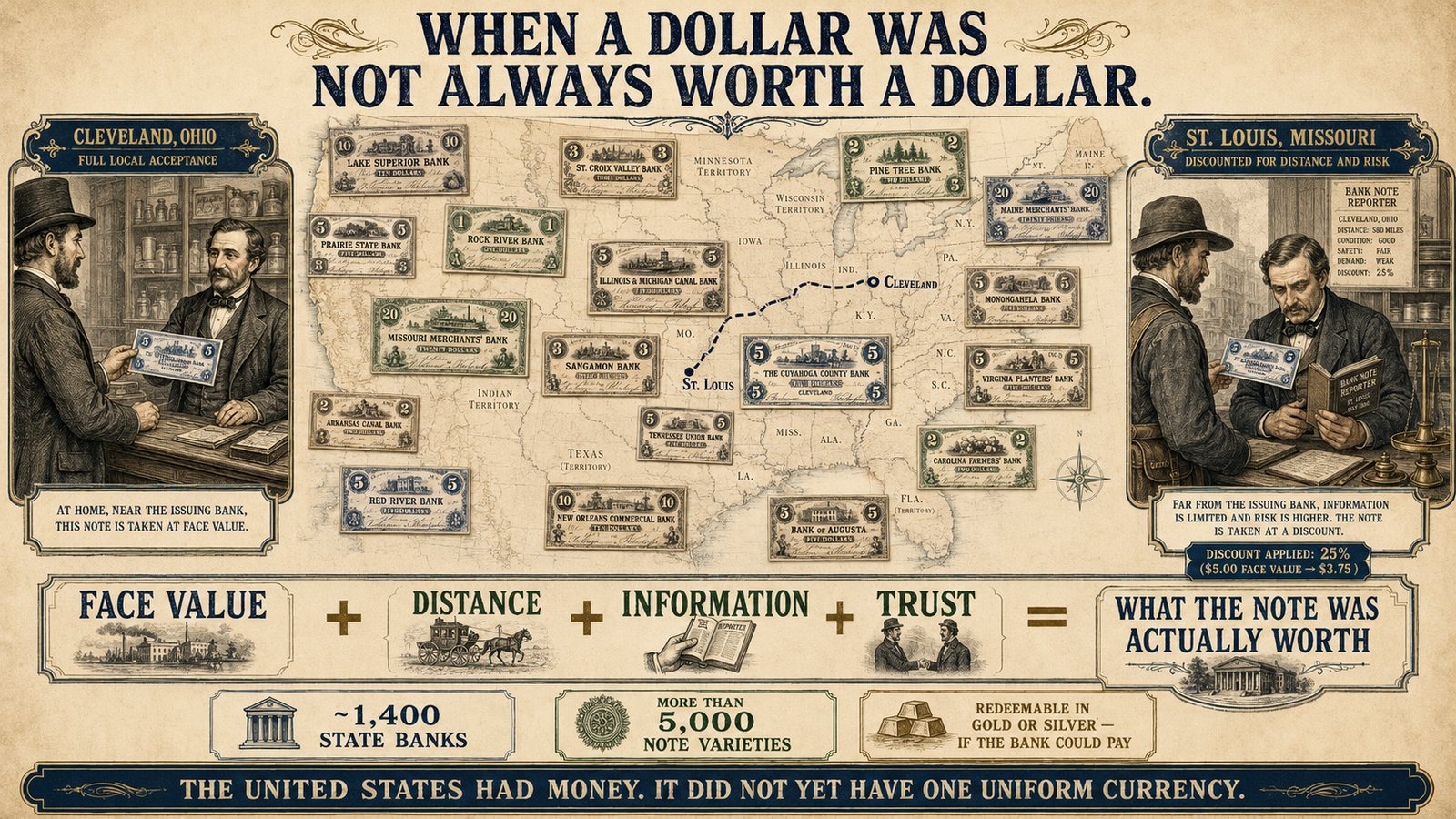
Businesses and travelers relied on publications sometimes called banknote reporters or counterfeit detectors — guides that listed banks, described their notes, and estimated how much the paper was worth. Imagine paying for dinner and watching the merchant consult a reference book to determine whether your five-dollar bill was really worth five dollars. The country had money, but not a truly uniform currency. The value printed on the paper was only part of its value. The rest depended on distance, information, and confidence.
A rumor could empty a bank
Banks did not keep enough gold and silver in their vaults to redeem every note and deposit simultaneously. They kept reserves they believed would be sufficient for normal demand, and lent the rest. The arrangement worked as long as people remained confident. But when customers suspected a bank might not have enough coin, they rushed to redeem their notes and withdraw their deposits before everyone else did. That was a bank run.
Even a solvent bank could be endangered if too many customers demanded cash at once. Fear could then spread — from one institution to connected banks, then unrelated banks in the same city, then across a state, and sometimes across the country. What began as a suspicion about one bank could become a banking panic. To preserve cash, banks curtailed lending; merchants lost working capital; businesses could not finance inventory; farmers could not borrow to move crops; workers lost jobs. A financial panic could deepen an ordinary downturn into a serious recession.
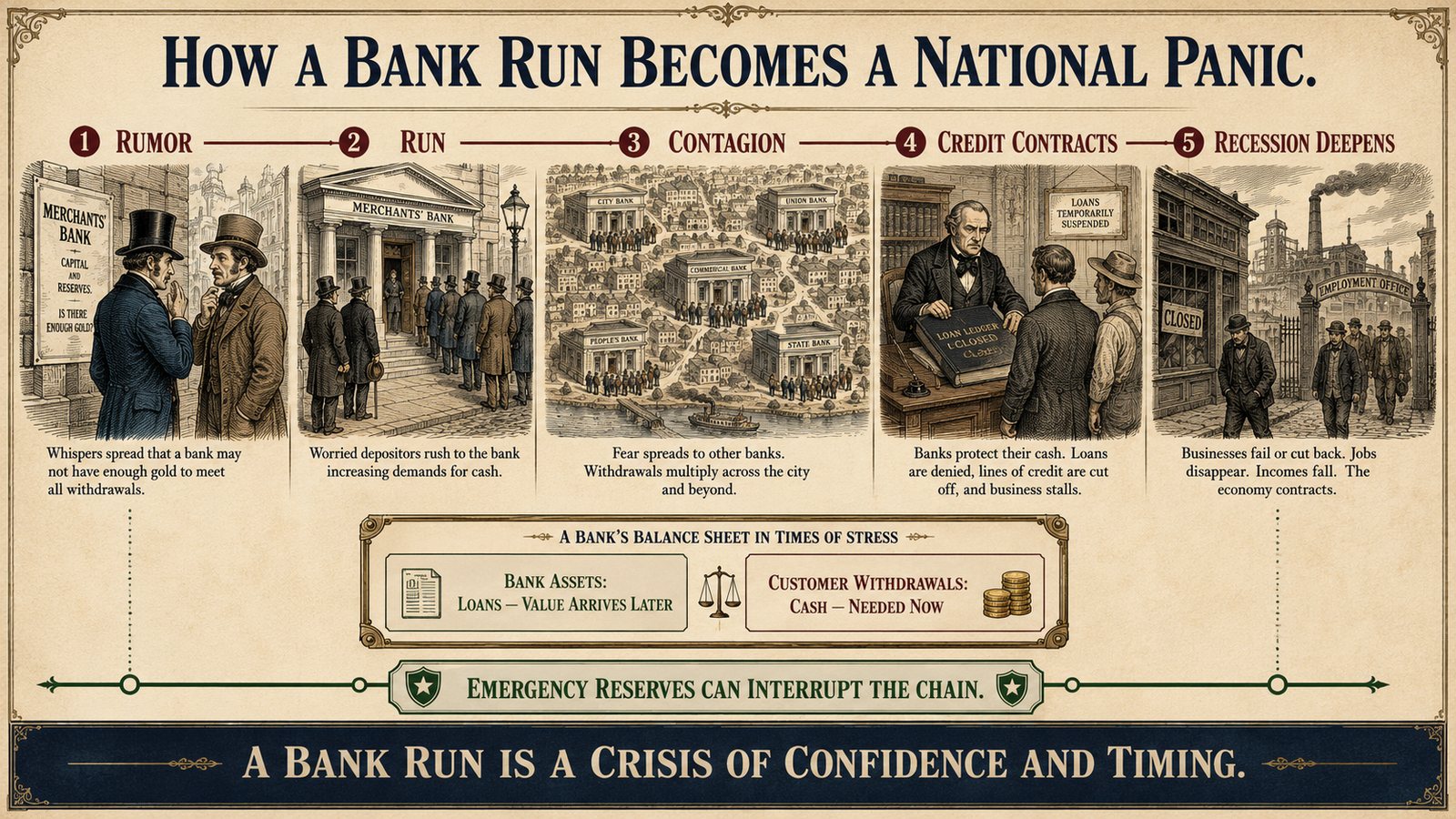
America experienced these episodes repeatedly during the 19th century. Humpage noted that the United States suffered more banking panics than other developed nations such as Britain, France, and Germany, with particularly severe contractions around 1873 and 1893. The Panic of 1907 is often remembered as the final crisis that created enough political momentum for the Federal Reserve. But it was not an isolated disaster. It was the latest warning in a long series.
The problem was not always too much money
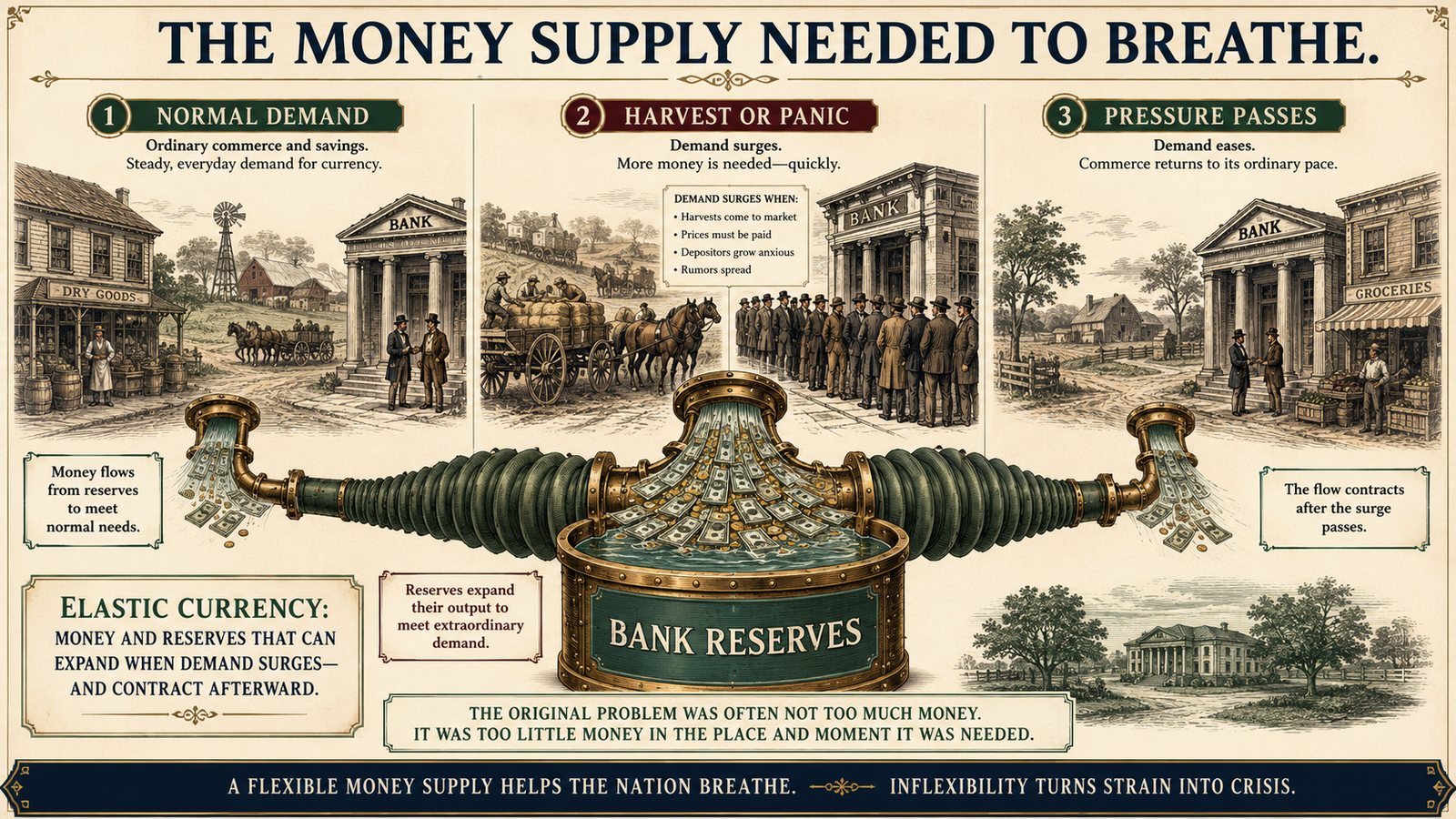
Today, monetary-policy debates often focus on whether the Fed has created too much money or kept interest rates too low. The original problem was frequently the opposite: there was not enough currency in the places where people suddenly needed it. Demand for cash could rise sharply during a panic, but also for ordinary reasons. In an agricultural economy, farmers needed more currency when crops were harvested, shipped, and sold. Money was seasonal — it moved with wheat, cotton, corn, and livestock. A local disaster, like the Great Chicago Fire, could also create sudden demand for cash in one region.
The monetary system needed to breathe — to expand when the public demanded more cash and contract when the emergency or seasonal pressure passed. Economists call this an elastic currency. Picture a town’s water system: ordinary capacity is fine most days, but during a major fire the community suddenly needs far more water. A system that cannot increase supply at that moment may be adequate in normal conditions and disastrously inadequate in an emergency. The pre-Fed banking system often behaved like a water system with no reserve pressure — when fear created the greatest demand for liquidity, the supply became least responsive.
America experimented with central banking — twice
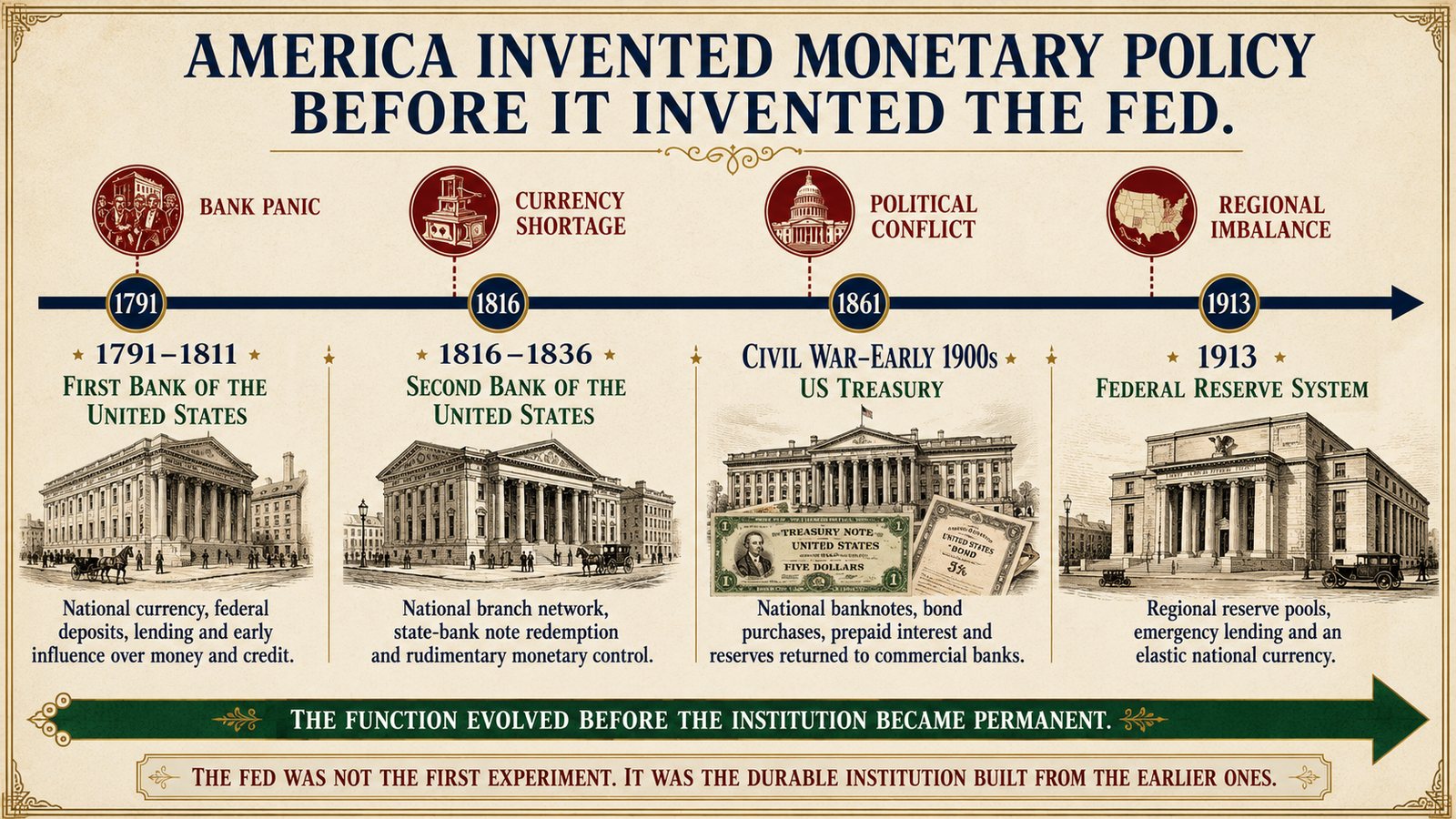
The Federal Reserve was not America’s first attempt at something resembling a central bank. The First Bank of the United States operated from 1791 until 1811; the Second Bank from 1816 until 1836. Each held a 20-year federal charter and was a private, profit-seeking bank with shareholders; the federal government owned 20 percent of each. Unlike ordinary state banks, they could establish branches across the country, held federal deposits, moved government funds, extended credit, and issued notes the government accepted.
Their scale gave them the ability to influence the supply of money and credit. The Second Bank accumulated state-bank notes through normal operations, then presented them for gold or silver. Redeem them rapidly and it removed reserves from state banks, contracting money and credit; hold them and state banks kept their reserves and could keep lending. It was rudimentary monetary policy before the phrase became commonplace — and it carried serious political weaknesses. State banks saw a privileged competitor; critics called it unconstitutional, elitist, and too concentrated; supporters said it provided a more stable currency. Both national banks ultimately lost their charters, and the country returned to a fragmented arrangement with no permanent central monetary authority.
The Treasury became an accidental central bank
When the First and Second Banks disappeared, the U.S. Treasury was left to perform some of the same stabilizing functions — with a peculiar problem. When the Treasury collected more than it spent and stored the surplus in its own vaults, those funds were effectively removed from the banking system. Banks lost reserves, credit contracted, and activity could weaken. A budget surplus might sound responsible, but where the government kept it mattered.
By the late 19th century the Treasury sometimes intervened directly. During the recession and panic beginning in 1890, it purchased outstanding Civil War bonds and prepaid interest on other federal debt — moving reserves out of government vaults and into commercial banks. Humpage characterized these as early versions of what would later be called open-market operations. But Treasury action was an imperfect solution: its capacity depended on the government’s fiscal position, and depositing money in selected banks exposed secretaries to accusations of favoritism. America had found pieces of the eventual solution. It had not yet created an institution permanently designed to carry it out.
What the Federal Reserve was originally built to do
Congress established the Federal Reserve System in 1913, after decades of instability and the alarming Panic of 1907. But the original Fed was not built around today’s policy framework. It did not begin with an explicit mandate to pursue maximum employment and stable prices — those objectives came later. The original Act emphasized a more immediate purpose: “to furnish an elastic currency,” provide a means of rediscounting commercial paper, and improve banking supervision.
Member banks held reserves with their regional Reserve Banks, so reserves sat in larger, more stable regional pools instead of scattered among thousands of institutions. When a member bank faced unusual demand for cash, it could borrow from its Reserve Bank against acceptable collateral, at a rate high enough to discourage treating emergency borrowing as cheap funding. The mechanism was meant to move reserves into the banking system when legitimate demand rose, then withdraw the support after conditions normalized. The Fed was not expected to make recessions impossible — only to make the system less vulnerable to the recurring pattern in which fear created a demand for cash, the cash supply failed to respond, banks stopped lending, and the panic intensified itself.
Gold still ruled the monetary world
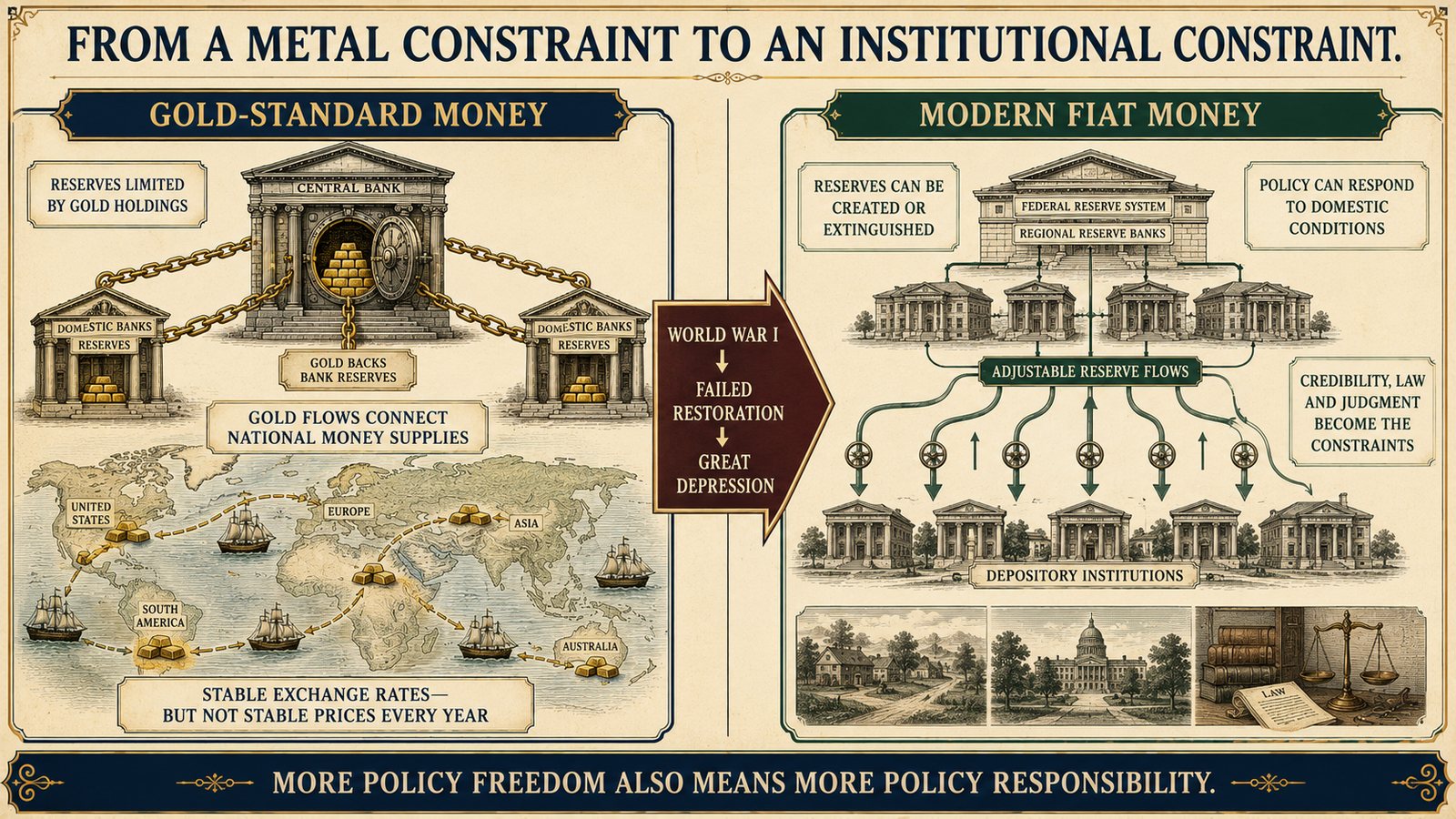
The Fed created in 1913 was not yet the fully modern monetary authority we recognize today. The United States was still connected to the gold standard, which constrained the amount of reserves and money that could be created and linked the monetary conditions of countries on the standard. If gold flowed out, reserves tightened; if it flowed in, the system could expand. Over long periods, gold-standard countries tended to experience related price movements and relatively stable exchange rates — but not stable prices every year. Humpage described substantial Civil War inflation, a long decline toward the 1890s, then rising prices again as new gold discoveries increased the monetary supply. The system could produce inflation. It could also produce prolonged deflation.
World War I severely disrupted the international gold system; attempts to restore it in the 1920s proved fragile; the Great Depression produced further abandonment. Once money was no longer redeemable for gold, monetary authorities could create or destroy reserves without waiting for more metal to be mined or transferred. For Humpage, this transition produced the two defining features of modern monetary policy: a country could conduct policy independently of the international gold standard, and its central bank could create and extinguish reserves. Those capabilities made modern monetary policy possible — and placed enormous responsibility on human judgment.
The human institution behind the marble walls
Part of the pleasure of Humpage’s talk was that he did not present this history like a museum guide reading labels from behind glass. He warned the audience they might want their introductory applause back by the time he finished. He declined spelling questions because people who had known him in grade school were present. Asked what monetary purpose the gold at Fort Knox now served, he joked that he had assumed Goldfinger had taken it. Asked about the creation of the FDIC, he simply admitted he was not prepared to explain it. The humor made the talk feel less like an institution defending itself and more like a historian inviting the audience into an unfinished investigation.
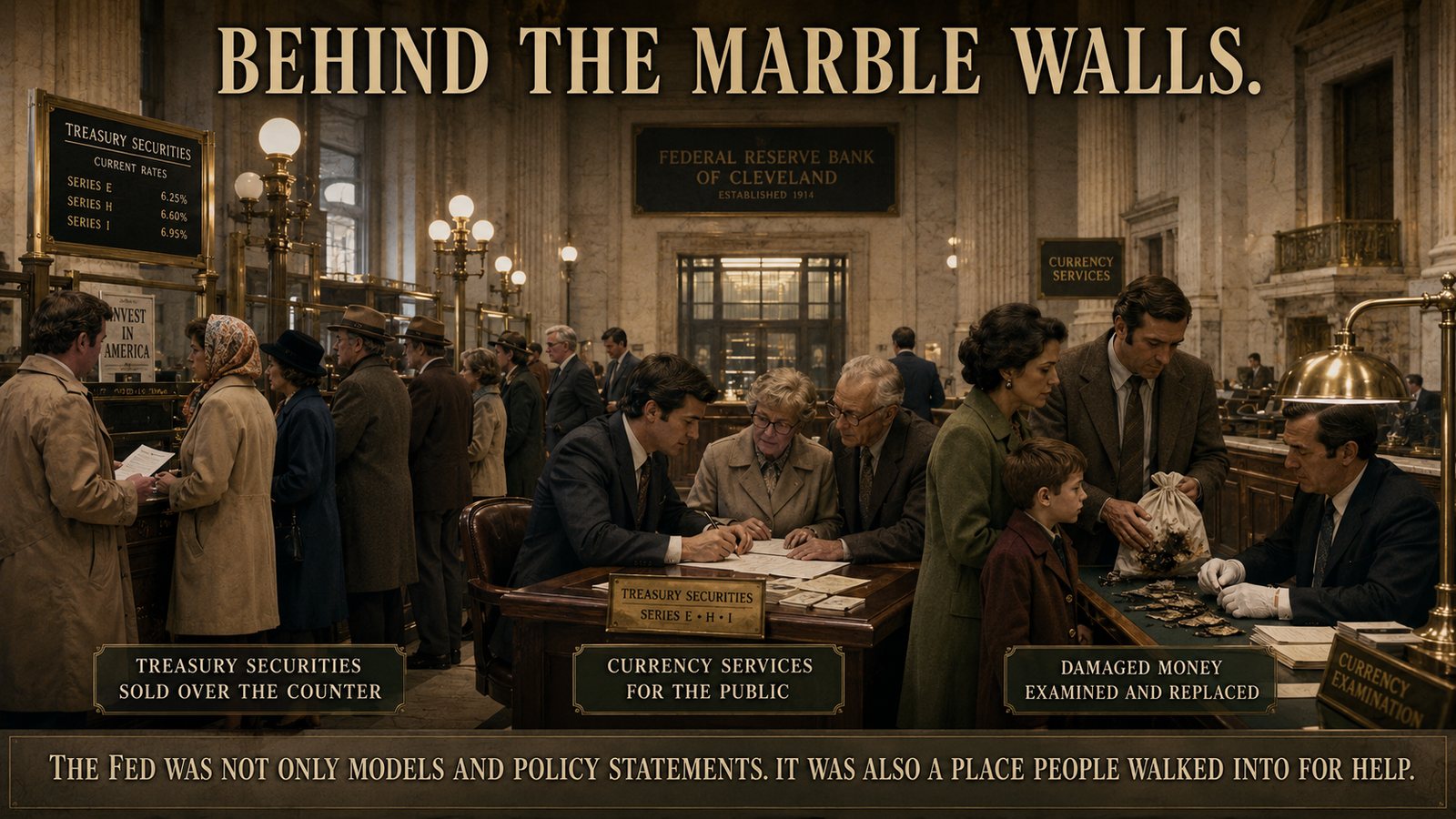
He also offered a glimpse of the Fed as an everyday public institution. When he arrived at the Cleveland Fed in November 1973, people could still enter the grand public lobby to purchase Treasury securities; new employees were taught to process the transactions in case a rush occurred. People brought damaged currency to the bank — someone whose house had burned might arrive carrying blackened bills, and if enough of a note remained identifiable, the damaged currency could be replaced. Today the Fed is imagined as a remote institution of models and press conferences. Within living memory, it was also a place where someone might walk through the marble lobby carrying a bag of scorched dollar bills.
Did the Federal Reserve solve the problem?
Not completely, and Humpage did not claim that it did. The United States still experiences recessions; banks can still fail; markets still panic; inflation can still damage purchasing power. A central bank can respond too slowly, intervene too aggressively, misunderstand the economy, or communicate poorly, and its power raises hard questions about independence and accountability.
The narrower historical argument is more persuasive. The Federal Reserve created capabilities the fragmented 19th-century system lacked: a more elastic supply of currency and reserves, a standing lender able to supply liquidity during stress, pooled reserves rather than isolated ones, and a regional structure that gathers information from different parts of the country. Each of the 12 Reserve Banks developed research and relationships that can reveal changes before official statistics do. The decentralized structure also encourages disagreement — and that debate is part of its design, not a defect. The Fed did not abolish economic uncertainty. It built a national institution capable of responding to it.
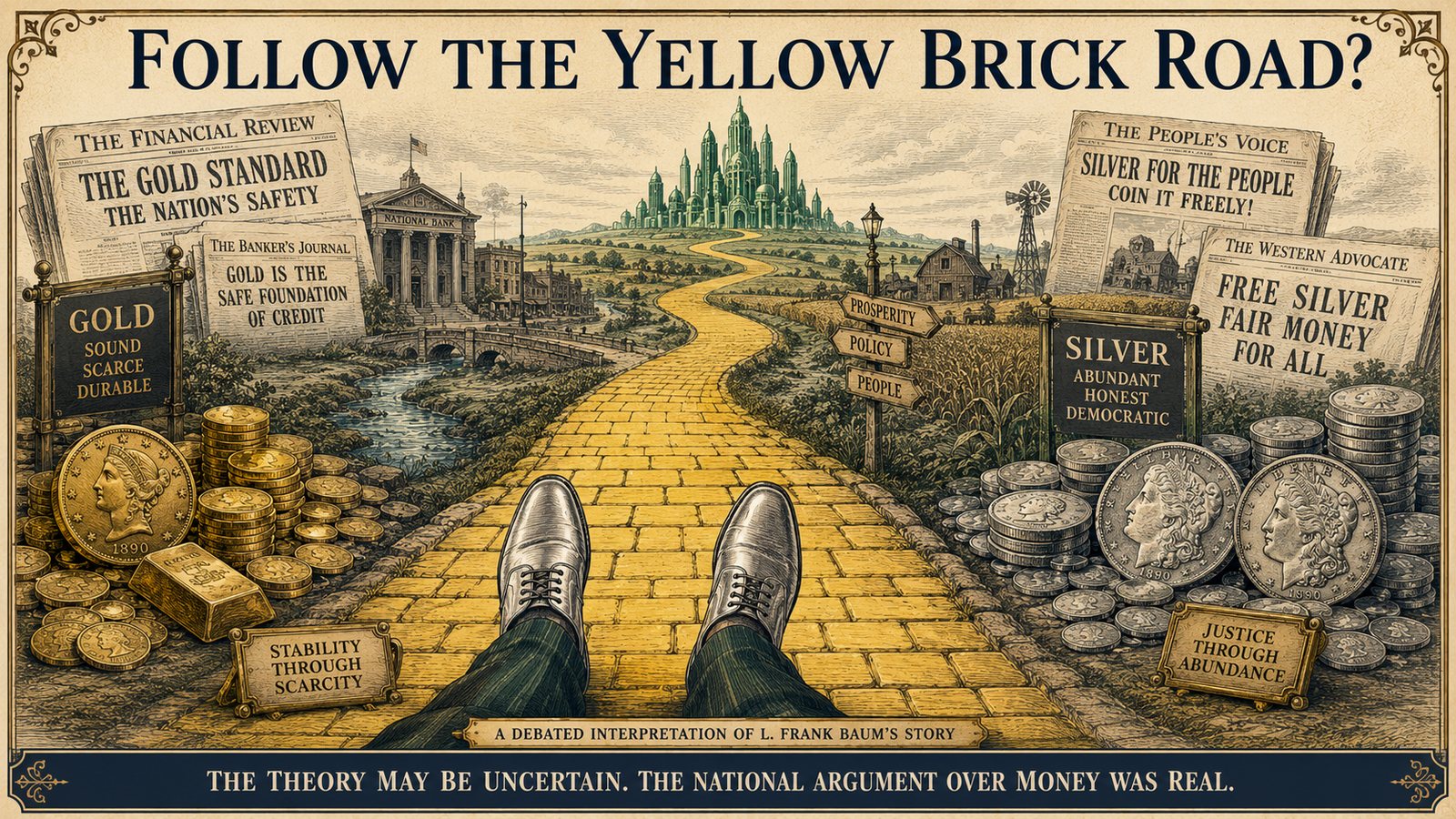
Follow the yellow brick road
The Cleveland Fed event ended with one final piece of monetary folklore. Some historians have read The Wonderful Wizard of Oz as an allegory about the late-19th-century struggle over the money supply. In L. Frank Baum’s original book, Dorothy wore silver shoes — not the ruby slippers of the film. Under the allegorical reading, the yellow brick road represents gold, the silver shoes evoke the campaign to add silver to the standard, and the journey toward the Emerald City becomes a story about American political and economic power. The evidence that Baum intended the whole book as a monetary allegory remains disputed — but it is a fitting ending.
The history of American money already contains the ingredients of a strange national fable: gold and silver; panics and political battles; thousands of competing pieces of paper; powerful financial institutions created and destroyed; a Treasury secretary named Salmon trying to finance a civil war; an Ohio posse leaping over a bank counter; crowds entering a marble Federal Reserve Bank to buy government securities; families carrying scorched money recovered from burned homes; and a nation repeatedly searching for an institution capable of restoring confidence when fear took control. The Federal Reserve was not a wizard waiting behind a curtain with all the answers. It was what America eventually built after learning, again and again, how frightening the journey could become without it.
Seven things worth remembering
- 1Monetary policy existed before the Federal ReserveThe First and Second Banks and the Treasury used lending, reserve movements, debt purchases, and note redemption to influence money and credit long before 1913.
- 2Early American paper money was fragmentedThousands of banknote varieties circulated, and a note’s value could depend on the issuing bank, its authenticity, local information, and the distance from where it could be redeemed.
- 3Bank runs are crises of confidence and timingA bank may own valuable assets and still fail when too many customers demand immediately available cash at the same time.
- 4The original problem was an inelastic currencyThe supply of cash and reserves could not expand quickly enough during harvest seasons, local disasters, or banking panics.
- 5The Fed was initially built for financial stabilityIts founding purpose centered on supplying an elastic currency and reducing recurrent panics — not on the modern dual mandate as we know it.
- 6Fiat money increased both freedom and responsibilityLeaving the gold standard gave the U.S. more control over its own policy, but made institutional judgment and credibility far more important.
- 7The Fed did not eliminate crisesIt created tools, reserves, regional intelligence, and a permanent institution intended to manage crises better than the unstable arrangements before it.
This is an independently written narrative summary and interpretation of the Cleveland Fed presentation. It is not affiliated with, endorsed by, or published on behalf of the Federal Reserve Bank of Cleveland or the Board of Governors of the Federal Reserve System.
Watch the video, listen to the audio, and read the transcript at the Cleveland Fed website.
Turn a topic like this into a live game
This story became a 10-question quiz played live in the room. See exactly how, or build your own in about a minute.