See a live quiz in action, start to finish
The best way to understand Quiz Showdown is to watch one game go by. Below is a real quiz a host generated in the app — Fed Monetary Policy from 1820 to Today — a natural fit for a class on banking and the evolution of money in the U.S., but the same flow works for a team meeting, a client event, a party, or a product giveaway, online or in person.
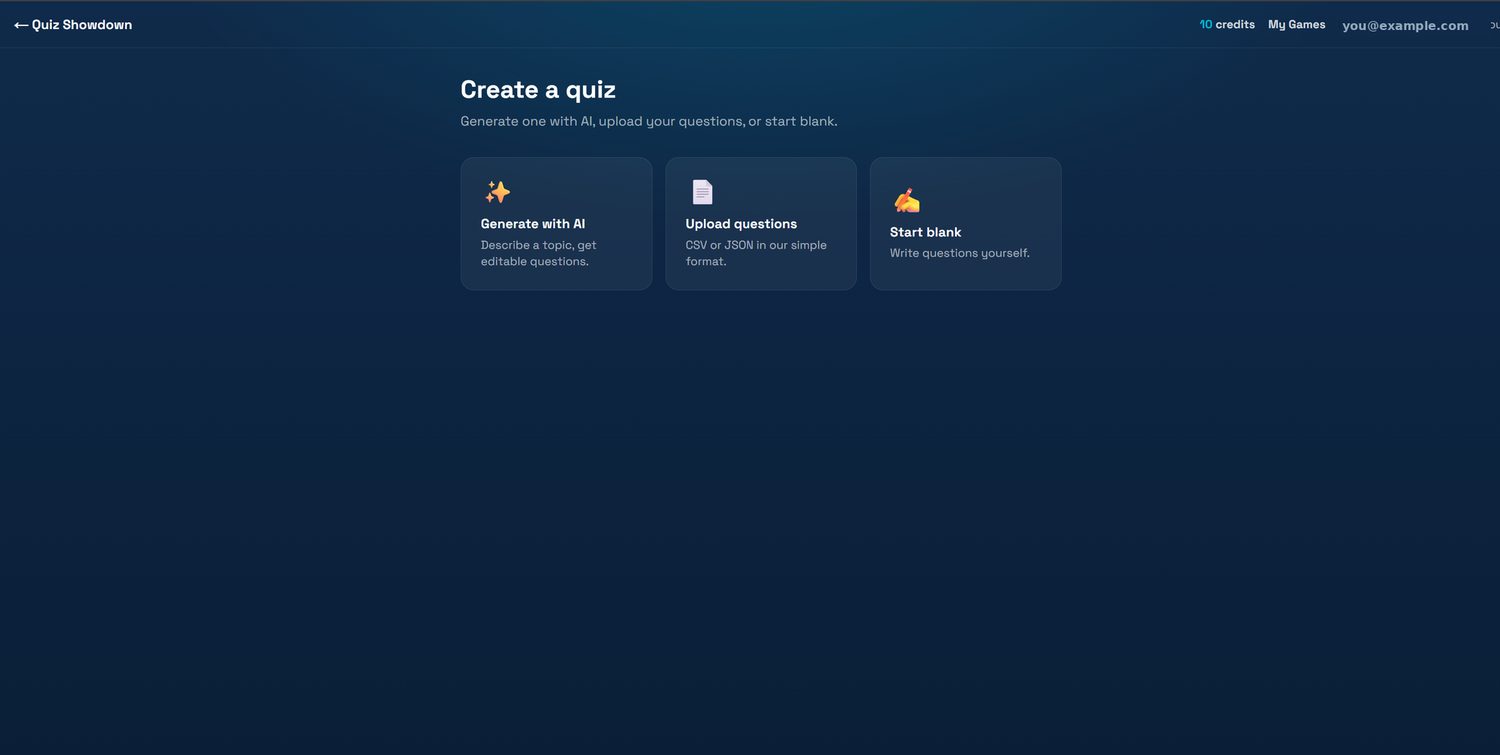
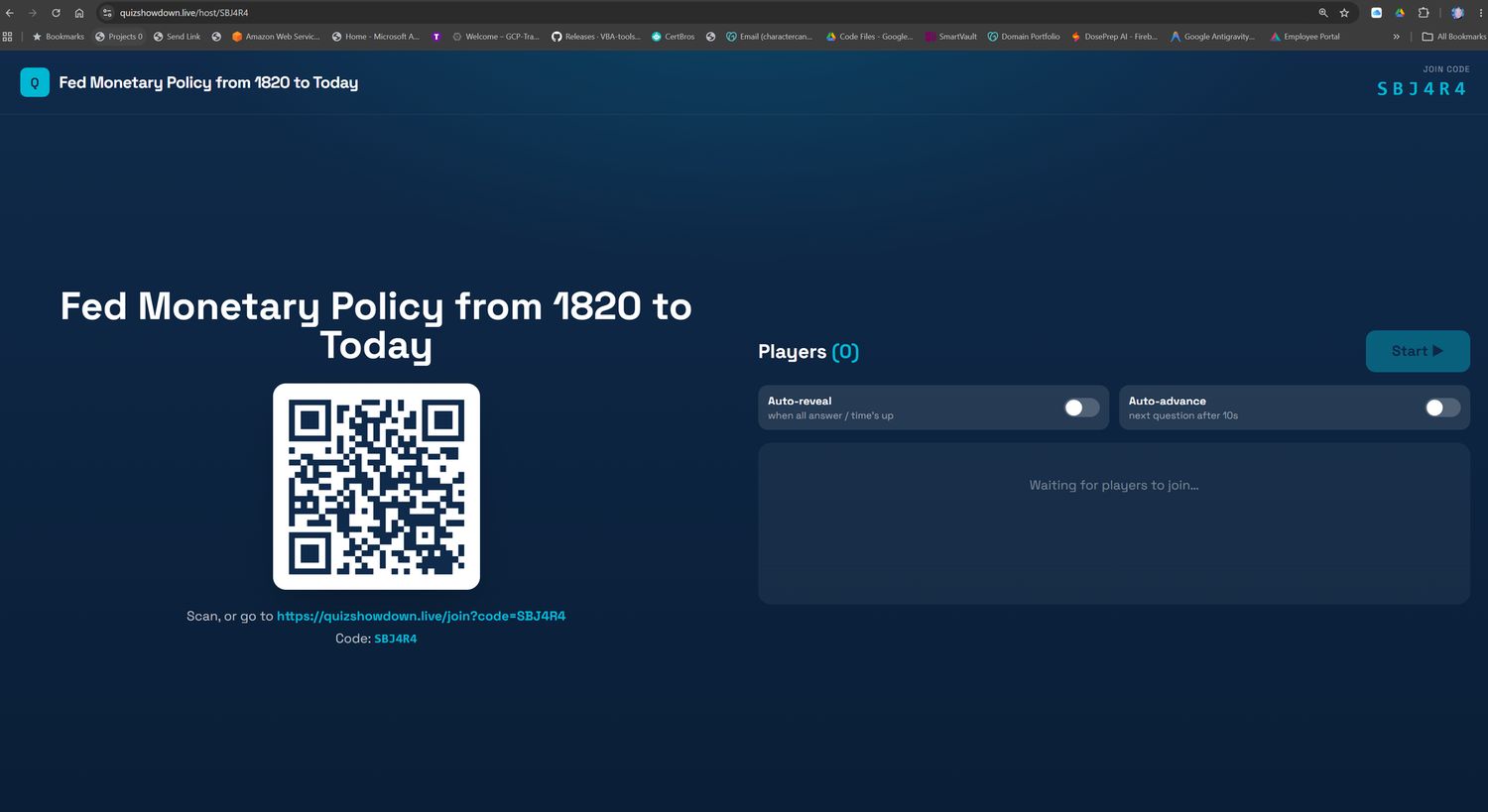
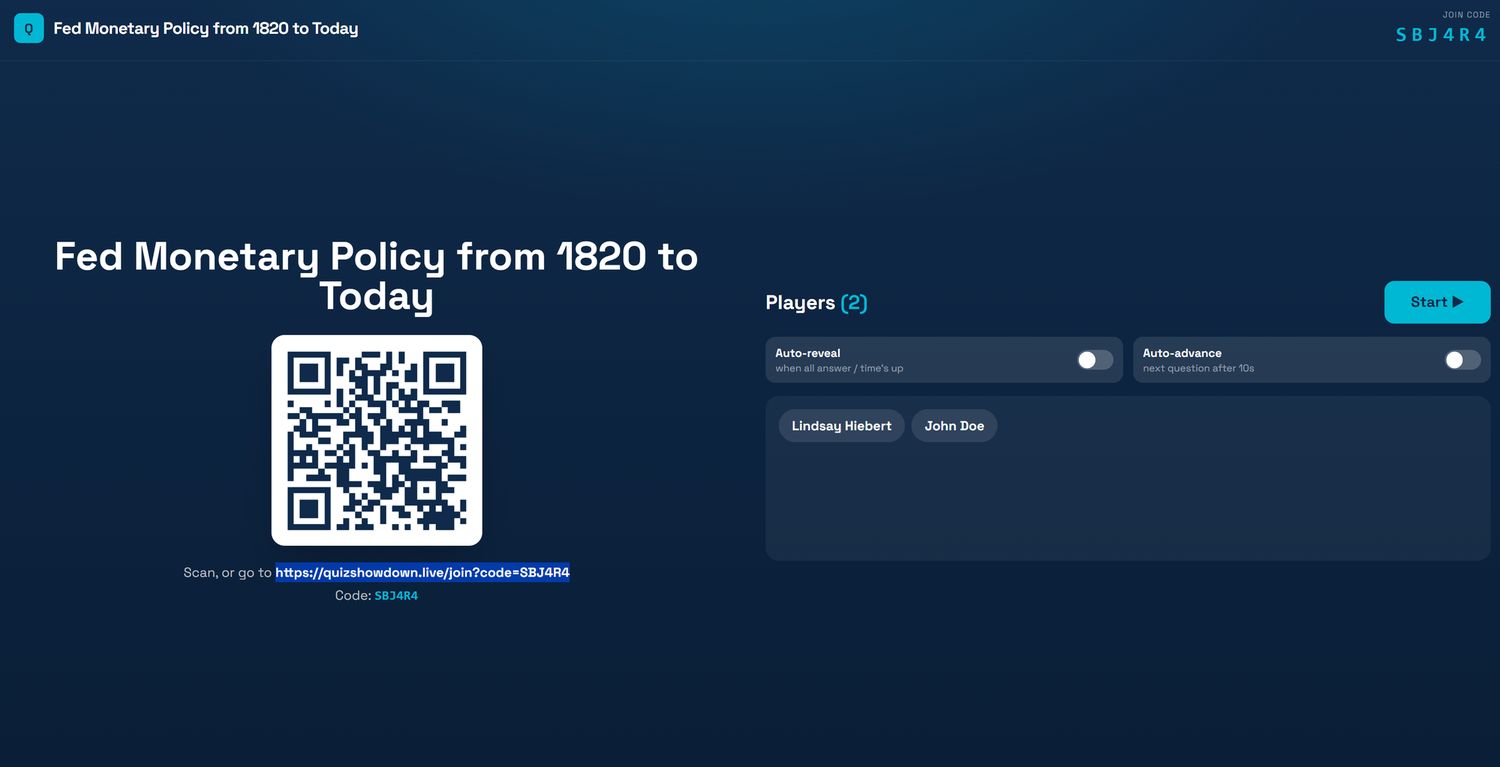
A host builds the quiz (with AI or their own questions), goes live, and the audience joins from their phones. Here is that sequence, screen by screen.


The full quiz — all 10 questions
Fed Monetary Policy from 1820 to Today · 10 questions · 20-second timer. The correct answer and a talking point are shown after each question during the live game — and gathered here so you can review them.
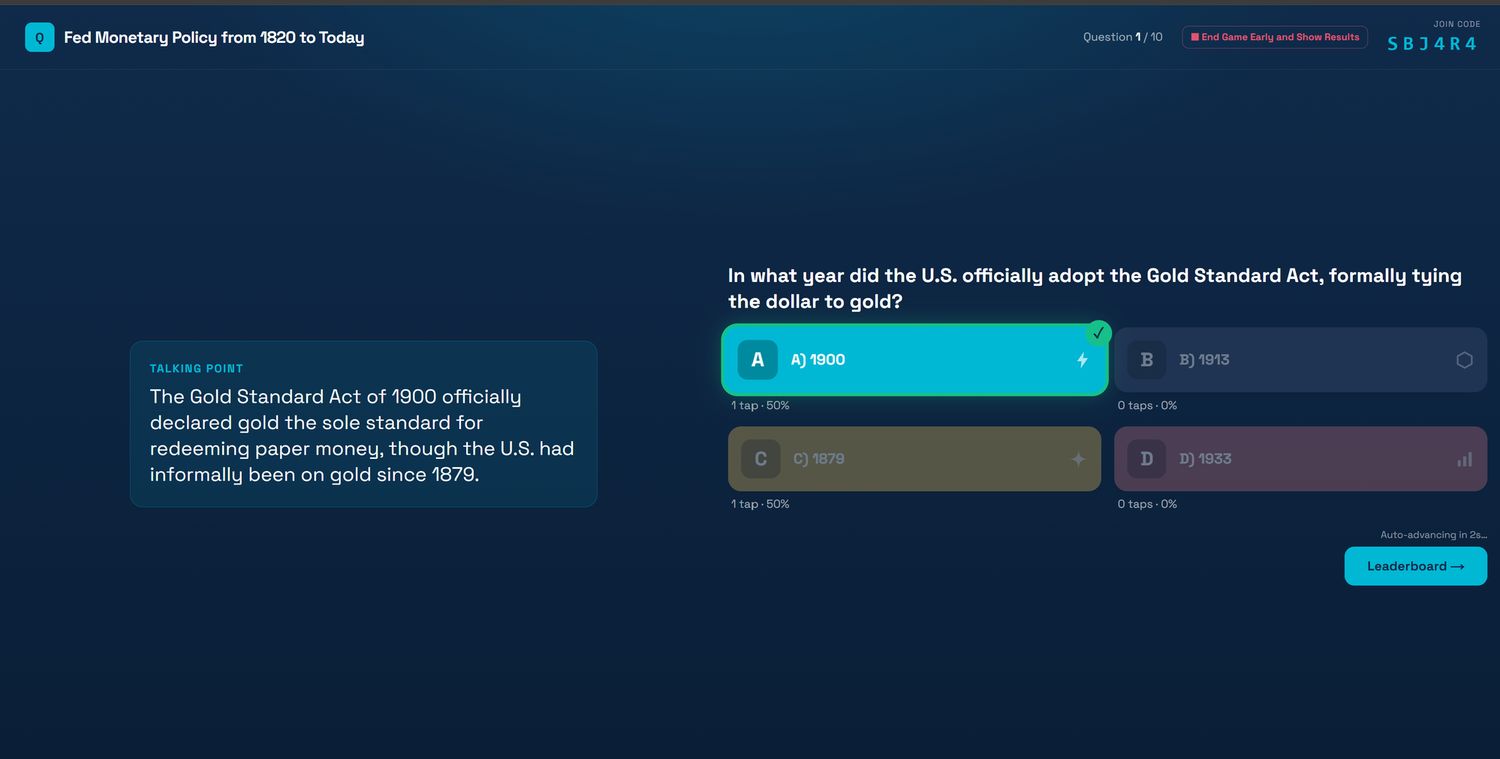
In what year did the U.S. officially adopt the Gold Standard Act, formally tying the dollar to gold?
The Gold Standard Act of 1900 officially declared gold the sole standard for redeeming paper money, though the U.S. had informally been on gold since 1879.
The Federal Reserve System was created in response to which major financial panic?
The catastrophic Panic of 1907, which J.P. Morgan personally helped stop, revealed the desperate need for a central bank and directly led to the Federal Reserve Act of 1913.
Show the middle questions (Q3–Q9)+
Which president signed the Federal Reserve Act into law?
Woodrow Wilson signed the Federal Reserve Act on December 23, 1913, creating the 12-district Federal Reserve System that still operates today.
FDR's Executive Order 6102 in 1933 did what to American citizens?
Executive Order 6102 made it illegal for Americans to hoard gold coins, bullion, or certificates, requiring citizens to sell their gold to the Federal Reserve at $20.67 per ounce.
The 1944 Bretton Woods Agreement pegged world currencies to which anchor?
Bretton Woods made the U.S. dollar the world's reserve currency, with other nations pegging their currencies to the dollar, which itself was convertible to gold at $35 per ounce.
Nixon's 'closing of the gold window' in 1971 ended which monetary system?
On August 15, 1971, Nixon suspended dollar-to-gold convertibility, effectively ending Bretton Woods and ushering in the modern era of free-floating fiat currencies.
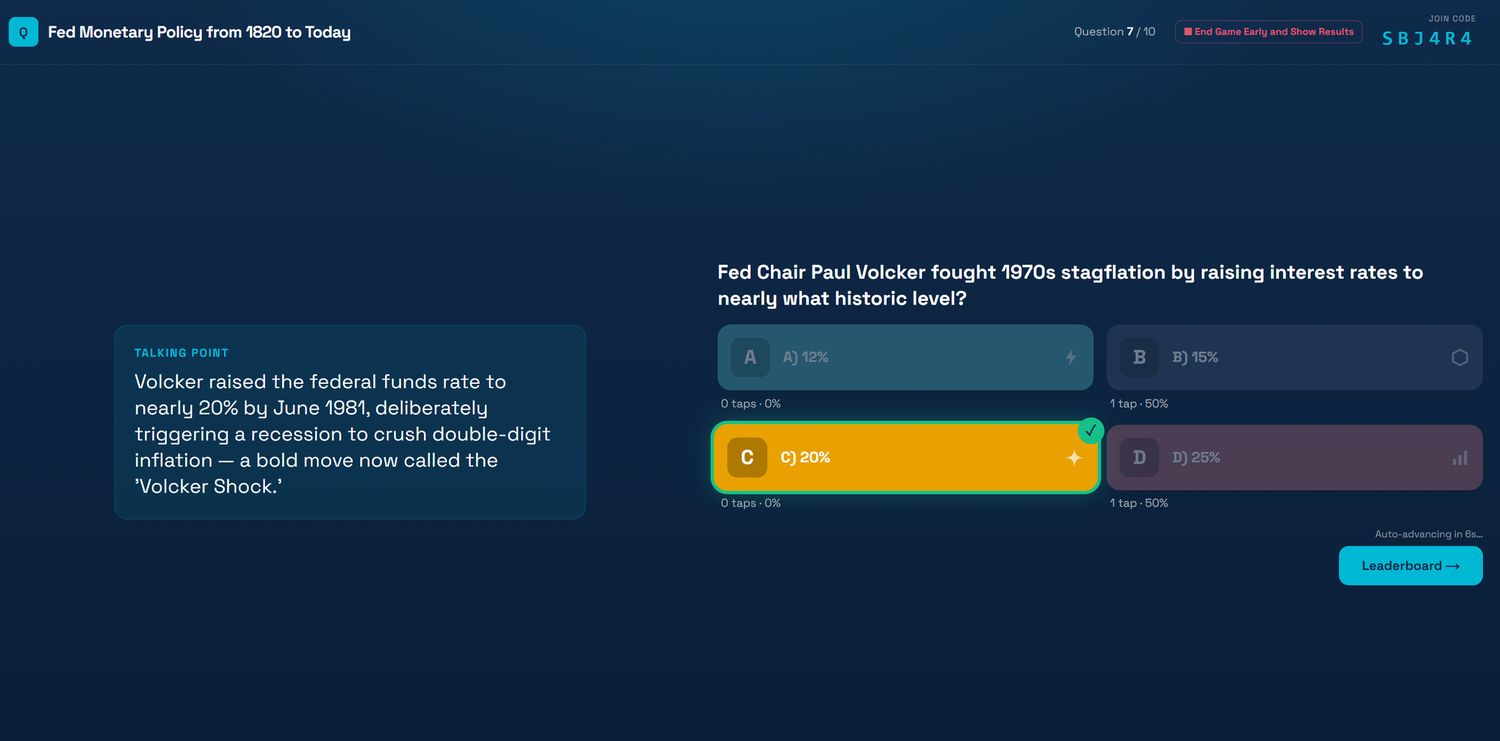
Fed Chair Paul Volcker fought 1970s stagflation by raising interest rates to nearly what historic level?
Volcker raised the federal funds rate to nearly 20% by June 1981, deliberately triggering a recession to crush double-digit inflation — a bold move now called the 'Volcker Shock.'
What policy tool did the Fed introduce for the first time during the 2008 financial crisis?
Quantitative Easing (QE), where the Fed buys large-scale assets like mortgage-backed securities, was first deployed in the U.S. in 2008 after interest rates hit the zero lower bound.
The Fed's 'dual mandate,' established by Congress, requires it to pursue price stability AND what else?
The Humphrey-Hawkins Full Employment Act of 1978 codified the Fed's dual mandate: maintaining price stability (controlling inflation) and promoting maximum employment simultaneously.
In 2020, the Fed adopted 'Average Inflation Targeting,' meaning it would allow inflation to run above 2% to make up for periods of what?
Average Inflation Targeting (AIT) was a landmark policy shift — instead of reacting immediately when inflation hit 2%, the Fed would let it run hot to compensate for past years of below-target inflation.
Make one like this — free to build
Describe any topic and get an editable quiz in about a minute. You only pay when you go live, and one run hosts the same quiz up to 10 games.
Create a quiz ▶Want the deeper story behind these questions? Read When America Kept Running Out of Money — a human-interest look at the century of bank runs and crises that led to the Federal Reserve. It's also published on Substack.