From one sentence to a live game: Organic Chemistry Fun Facts

If you are new to Quiz Showdown, this is what your first game looks like. We typed one sentence about organic chemistry, reviewed the ten questions the AI drafted, opened a live game, played it on two devices and re-asked the questions the room missed. It suits a chemistry class or a study group, and it works the same way for a team meeting or a family game night, in person or online.
1Step 1. Describe a topic
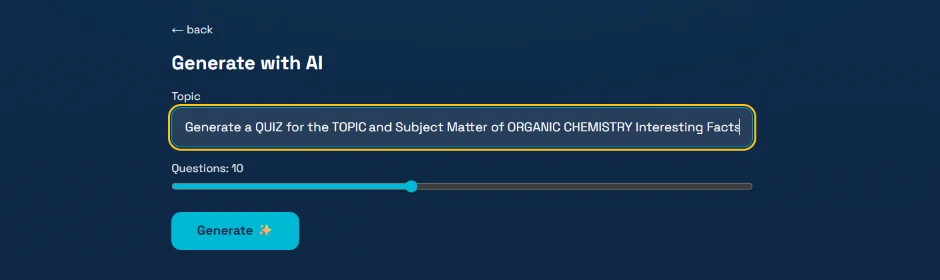
On the Create a quiz page, choose Generate with AI. Type a topic in your own words and choose how many questions you want. We asked for ten questions on organic chemistry interesting facts.
2Step 2. Let the AI draft it
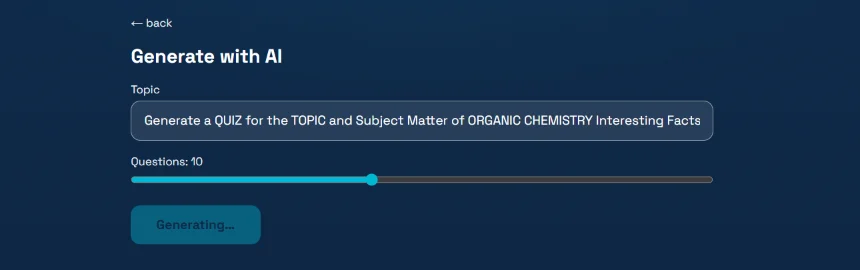
Press Generate and the AI writes the whole quiz: each question, four answers, the correct answer and a short talking point.
3Step 3. Review and edit every question
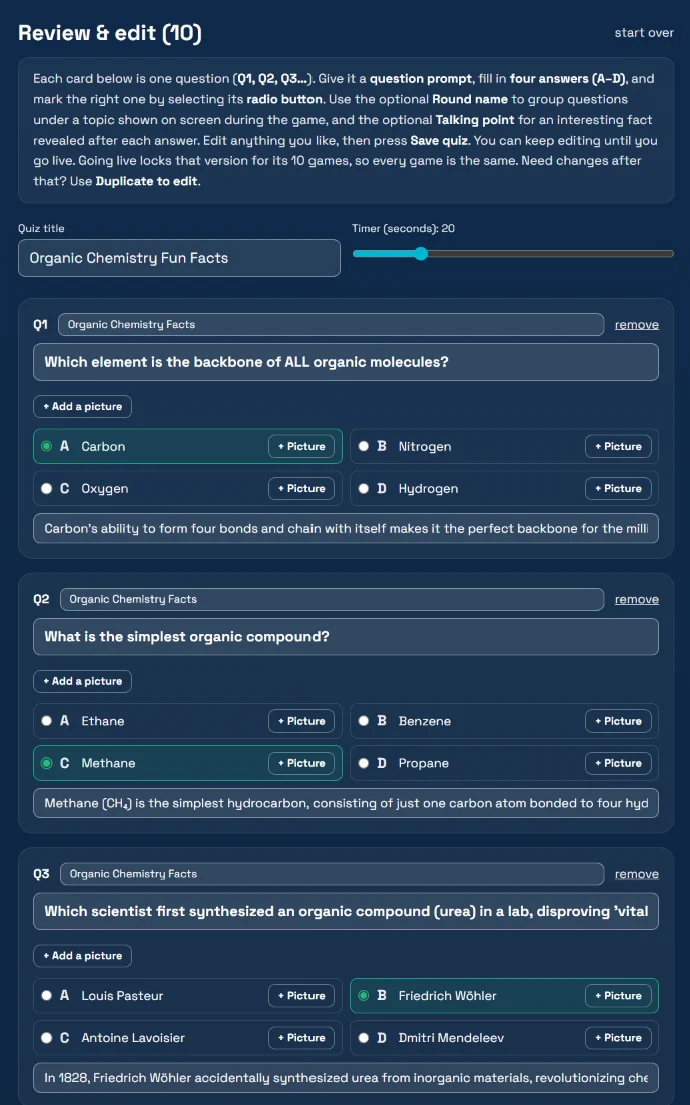
Every question arrives as an editable card. You can reword a question, change an answer, switch which answer is correct, add a picture or remove the question. The round name groups questions on screen during the game, and the talking point is the fact revealed after each answer, so the game teaches as well as tests.
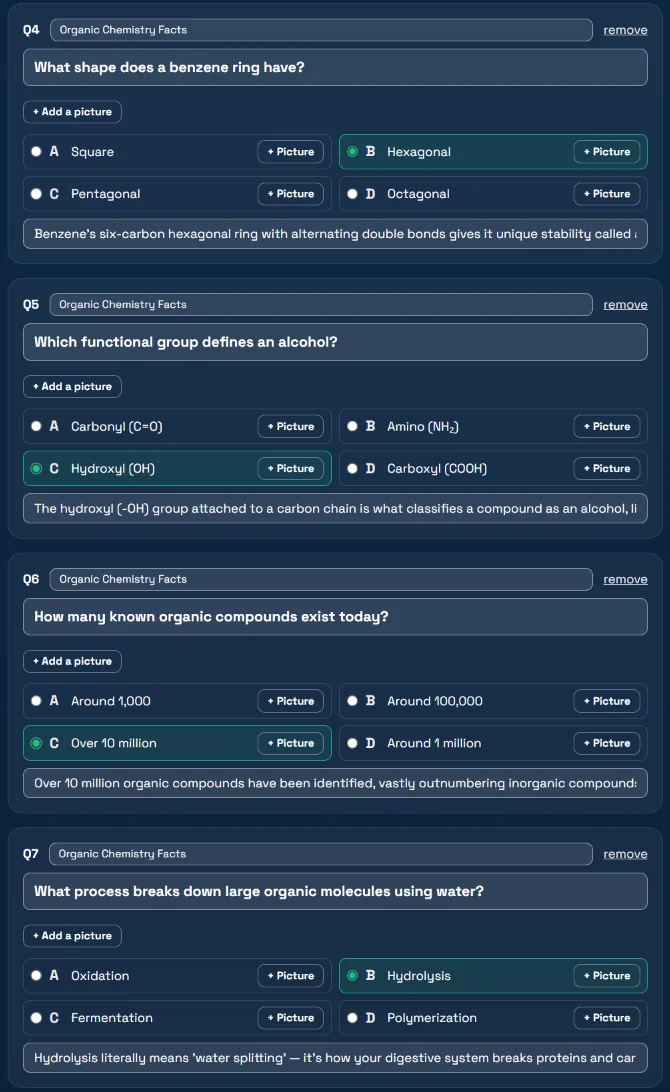
4Step 4. Save it to My Games
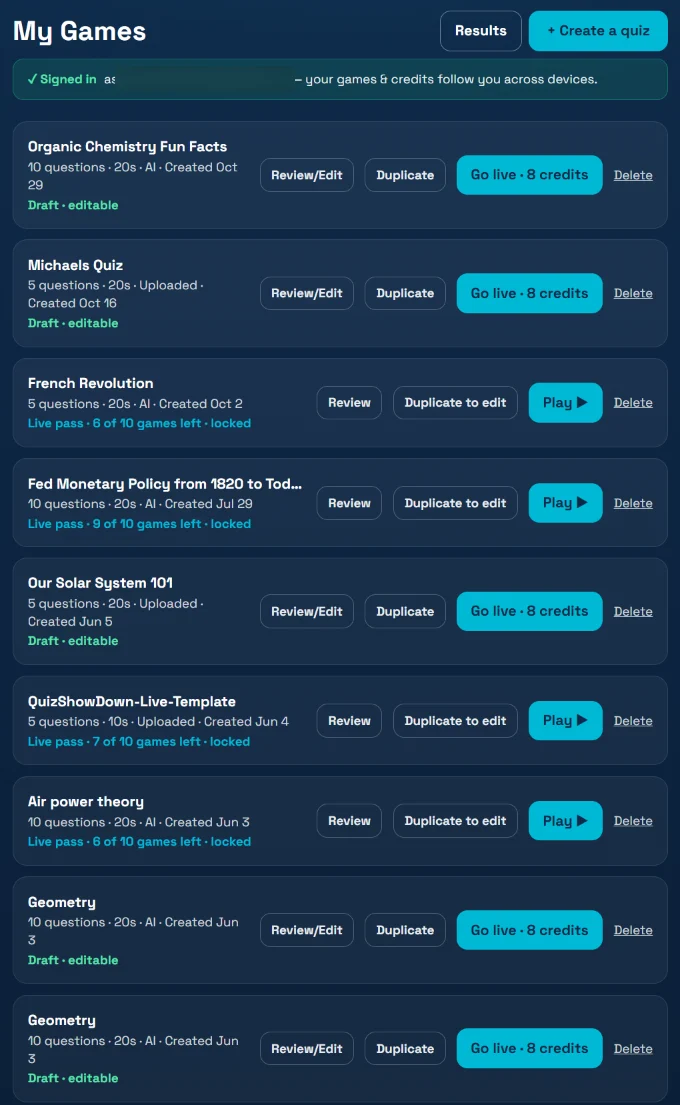
Press Save quiz and it joins your library as a draft. You can keep editing until you go live. Going live locks that version so every game plays the same, and Duplicate to edit gives you a fresh copy when you want changes later.
5Step 5. Go live and let players join
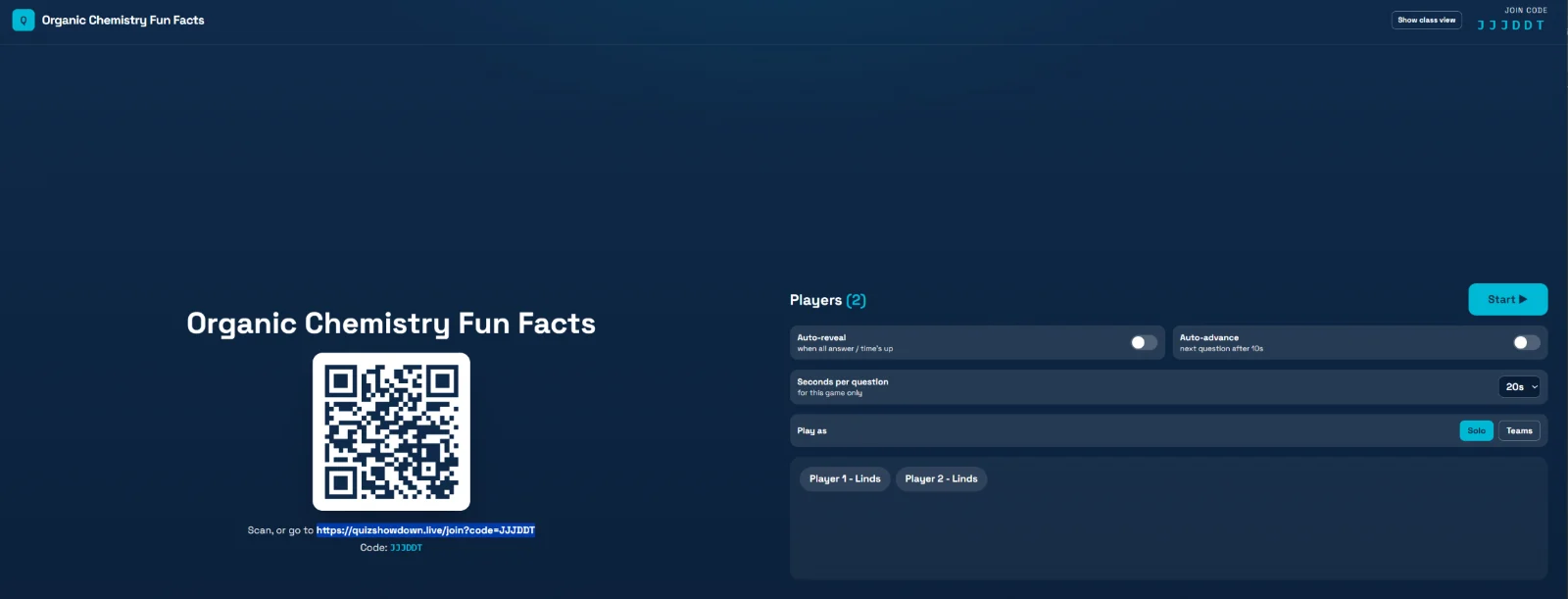
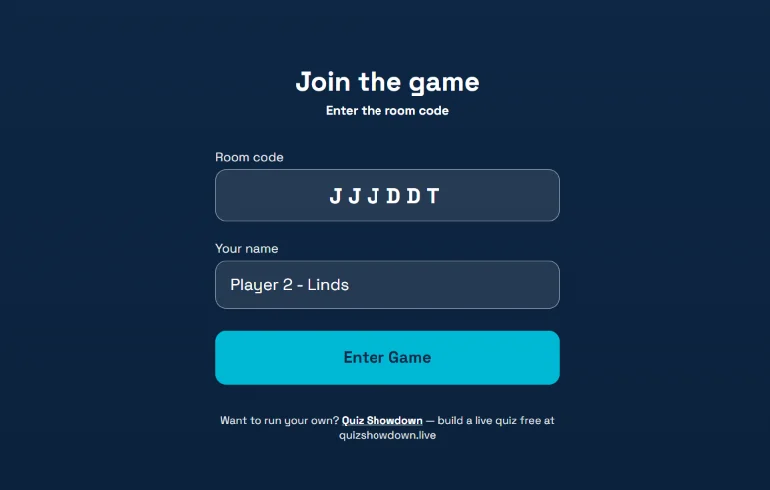
When you go live, the host screen shows a QR code and a join code (here, JJJDDT). Players scan the code or open the link, type a name and press Enter Game. They need no app and no account.
6Step 6. Set the pace
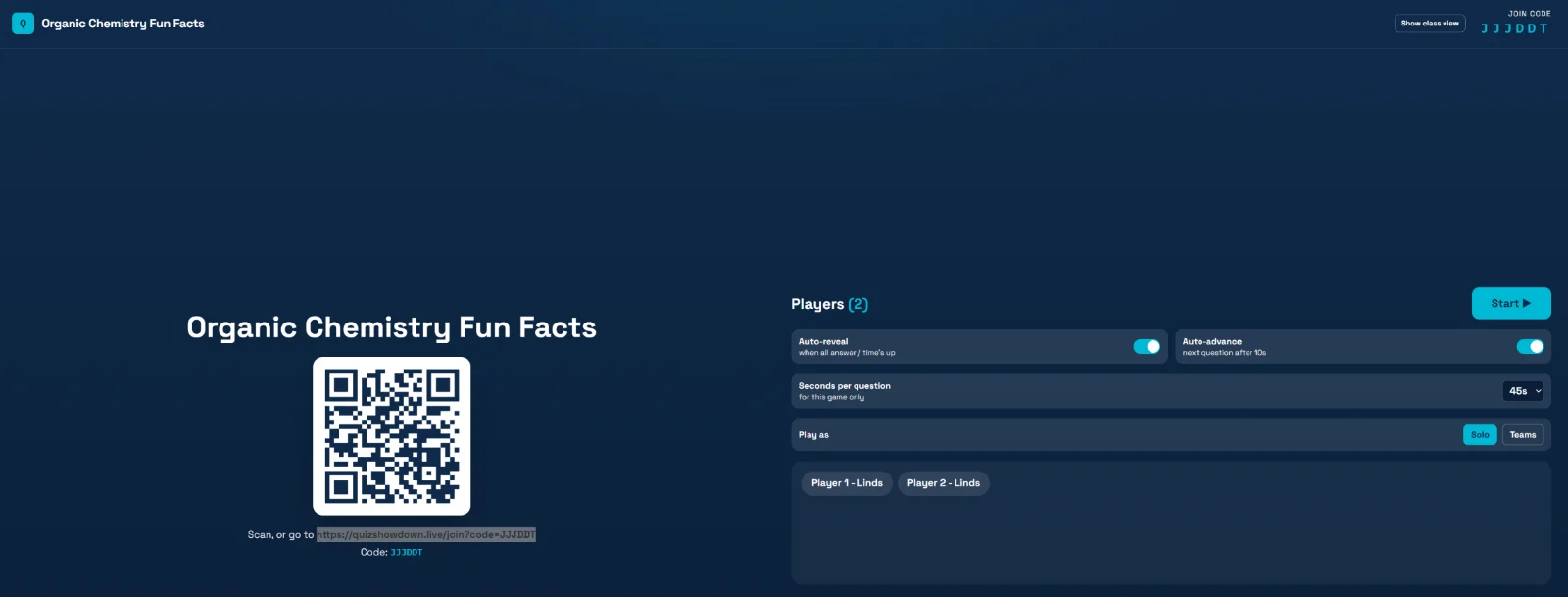
Before you press Start, choose how the game runs. Auto-reveal shows the answer when everyone has answered or time is up. Auto-advance moves on by itself. Seconds per question applies to this game only, and you can play as individuals or as teams.
7Step 7. Begin the round
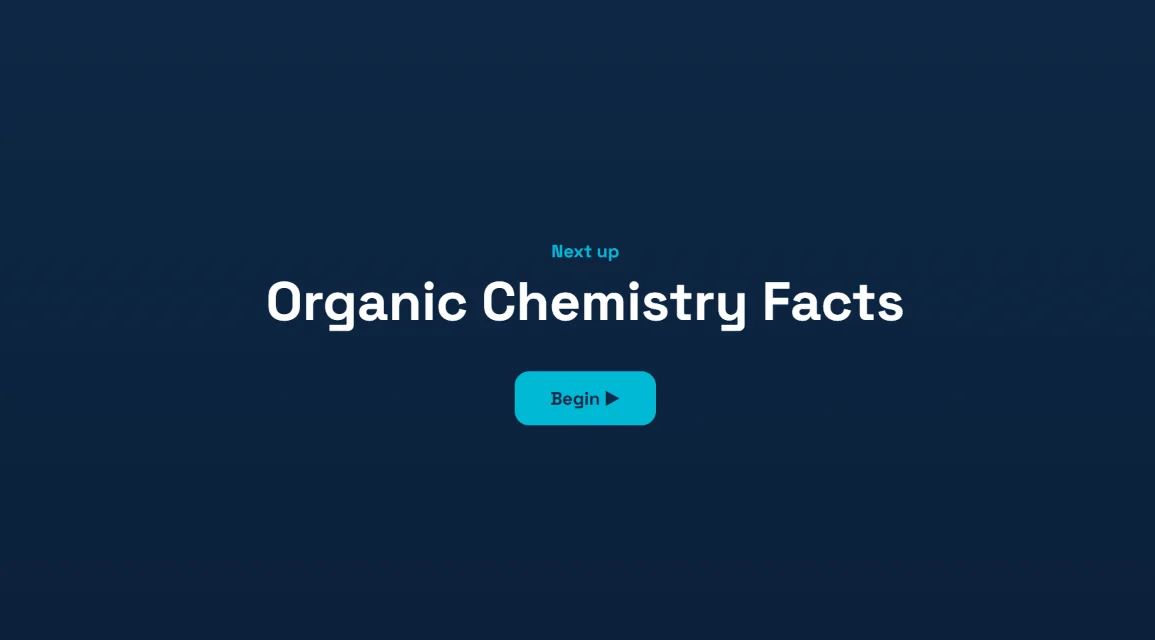
The round name from the editor becomes the title card the room sees before the questions begin.
8Step 8. Questions on the big screen
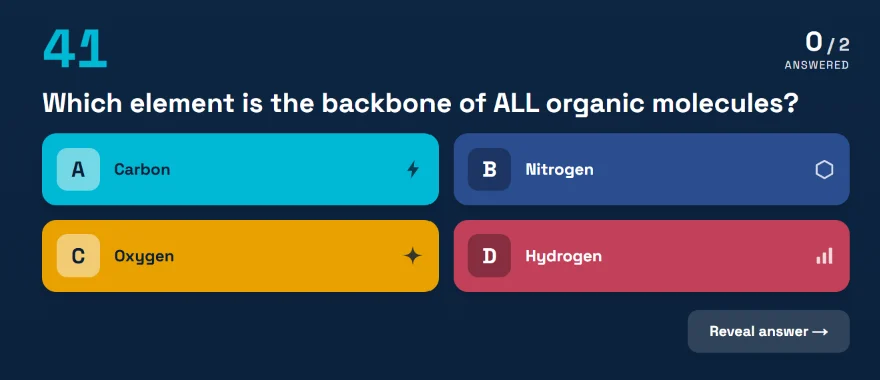
The host screen shows the countdown, the question and the four answers. Each answer has its own color and its own shape, so it is easy to match on any screen. The counter in the corner shows how many players have answered.
9Step 9. Players answer on their own devices
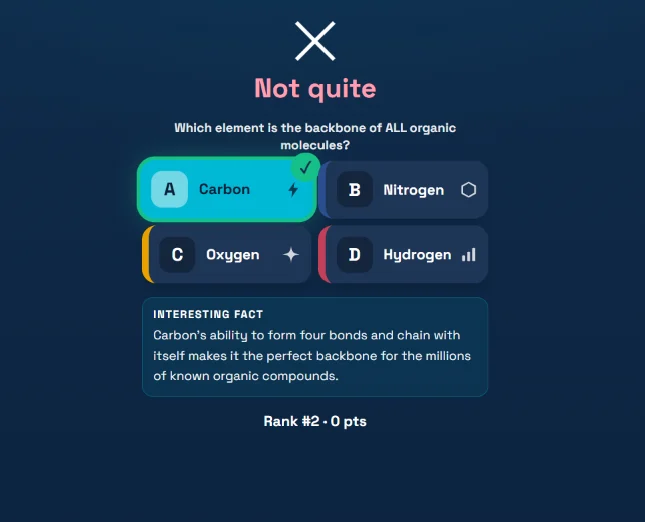
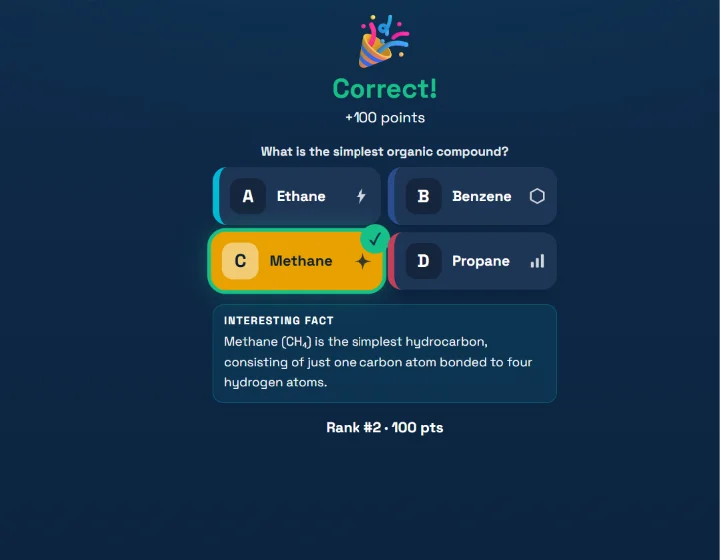
Each player answers on their phone, tablet or laptop. Right or wrong, they see the correct answer, the interesting fact and their current rank, so a miss turns into a moment of learning rather than just a lost point.
10Step 10. The reveal teaches the room
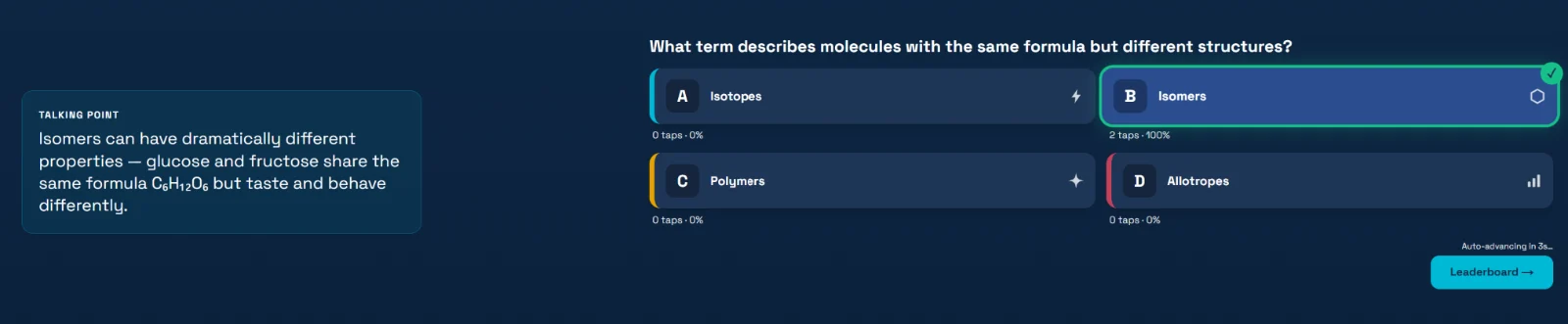
When the answer is revealed, the host screen shows the talking point beside the results, with how many players chose each answer. It is a natural moment to pause and explain.
11Step 11. Final results and the hardest questions
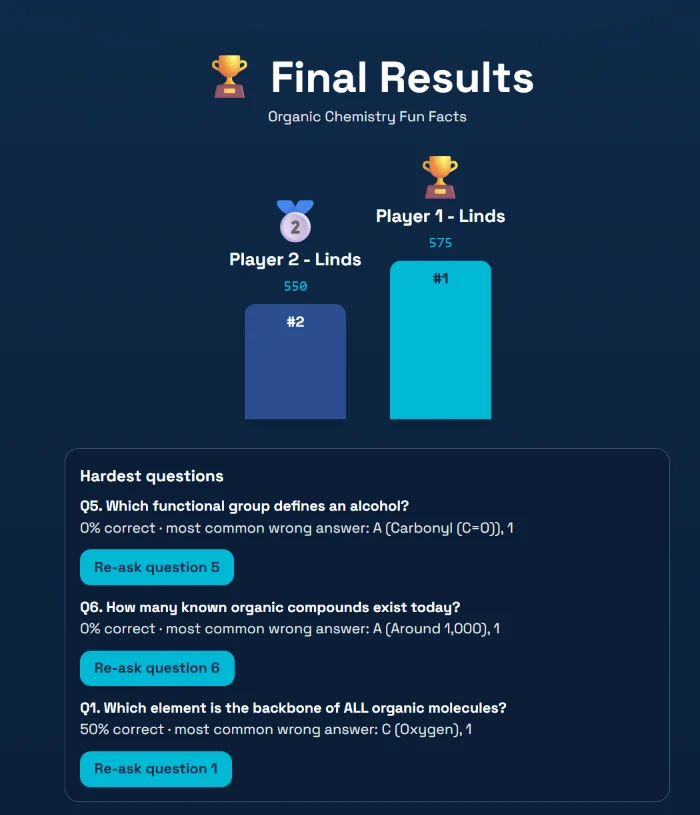
The game ends on a podium. Below it, Hardest questions lists the questions the room found hardest, with the percentage correct and the most common wrong answer, which shows exactly where a misunderstanding sits. Each one has a Re-ask button.
12Step 12. Re-ask, and see the room learn
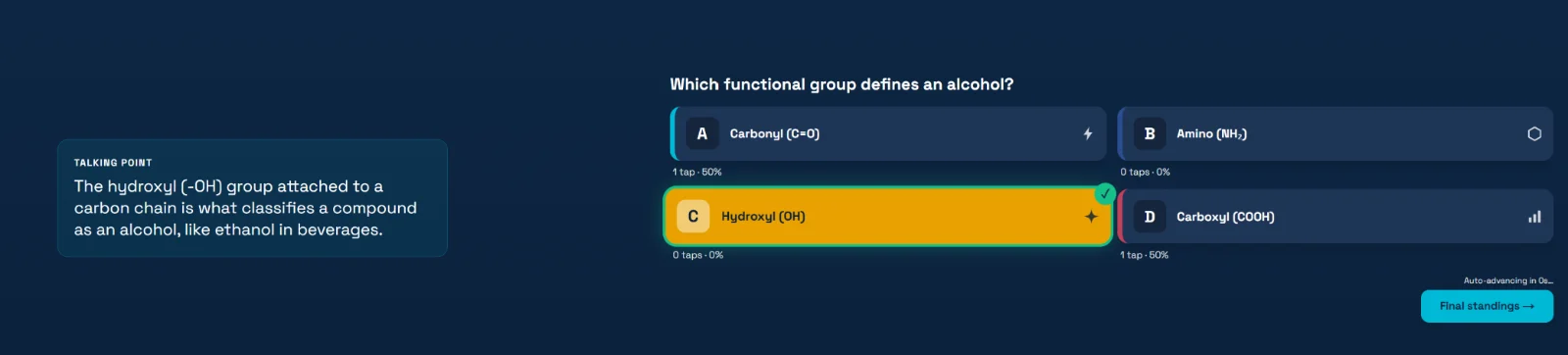

In our game, nobody chose hydroxyl for the alcohol question the first time, or on the first re-ask. After talking through the fact, we asked once more, and every player got it right. That is the point of a quiz in a classroom: finding the gap while there is still time to close it.
13Step 13. Final standings
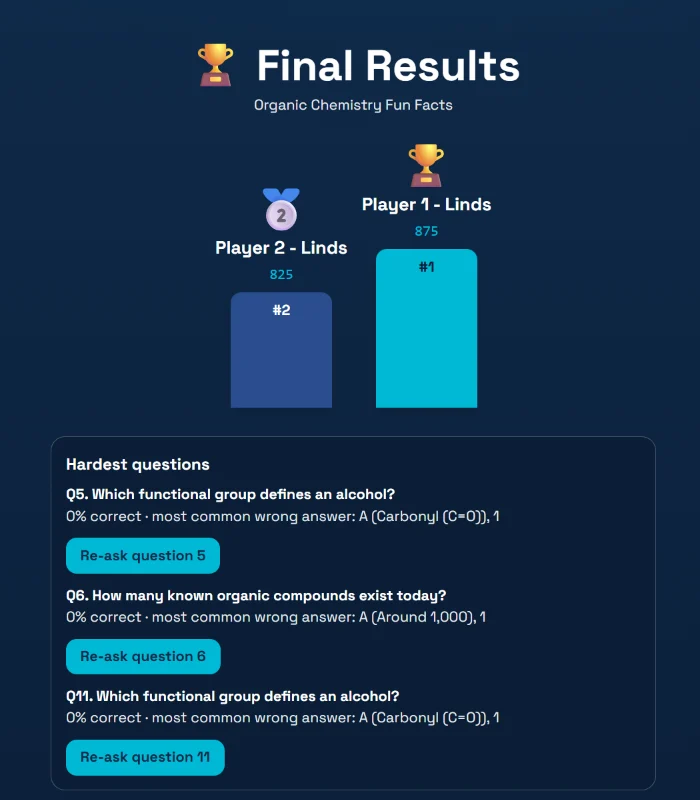
The re-asked questions count toward the final standings, so the podium reflects what the room learned during the game, not just what it knew at the start.
For classrooms: with Quiz Showdown for Schools, the teacher also gets a gradebook with one row per player and one column per question. Students join as Player 1, Player 2 and so on, and the teacher matches those to the class list on their own device, so no student names or data are stored. See Quiz Showdown for Schools
The full quiz: all 10 questions
The correct answer and its talking point appear live after each question. Here they are together for review.
Which element is the backbone of all organic molecules?
Carbon's ability to form four bonds and chain with itself makes it the backbone for the millions of known organic compounds.
What is the simplest organic compound?
Methane (CH₄) is the simplest hydrocarbon, one carbon atom bonded to four hydrogen atoms.
Show the middle questions (Q3–Q9)
Which scientist first synthesized an organic compound (urea) in a lab, challenging the "vital force" theory?
In 1828, Friedrich Wöhler made urea from inorganic materials, a turning point for chemistry.
What shape does a benzene ring have?
Benzene's six-carbon ring gives it a special stability called aromaticity.
Which functional group defines an alcohol?
The hydroxyl (-OH) group attached to a carbon chain is what makes a compound an alcohol, like ethanol.
How many known organic compounds exist today?
Millions of organic compounds have been identified, far outnumbering inorganic compounds, thanks to carbon's versatile bonding.
What process breaks down large organic molecules using water?
Hydrolysis means "water splitting." It is how your digestive system breaks proteins and carbohydrates into usable pieces.
Which organic compound gives red ants their sting?
Formic acid (HCOOH) is named after the Latin word for ant, formica, and is the simplest carboxylic acid.
What term describes molecules with the same formula but different structures?
Glucose and fructose share the formula C₆H₁₂O₆ but taste and behave differently.
Which organic polymer makes up most of a spider's web?
Pound for pound, spider silk is stronger than steel, one of nature's most remarkable organic polymers.
Make your own, free to build
Describe a topic and get an editable quiz in moments. Building and editing are free, and you only use credits when you go live.
Create a quiz ▶See another full game: See a live quiz in action: Fed Monetary Policy from 1820 to Today